Eggnog Creation

I do not really know my way around the kitchen, so putting together any number of ingredients and putting them through some kind of process is always an adventure for me. However, every once in awhile, I get the desire to try something new. Given that today is Christmas, that I’d like to learn more about making interesting cocktails, and that I found an article in the New York Times about a Butterscotch Scotch Eggnog, I figured I would give it a shot.

Below are some of the early shots of creating this concoction. As I write this, the three main components are sitting in my refrigerator, standing by to transport to a friend’s home for consumption. I’ll try to get more photographs there.

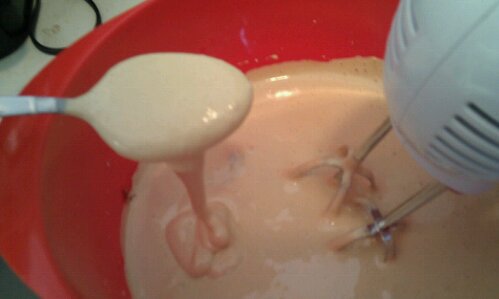
1. The first thing I had to do was create the butterscotch. I didn’t realize this could be done at home, or how simple it is. I was merely following directions when I suddenly realized I was looking at a bowl of butterscotch. This first photo are 12 egg yolks (I separated them first! First time!) and two teaspoons of vanilla.

image

2. Here, we have a cup of brown sugar on the right, and the alcohol on the left. The alcohol is where I probably made my biggest mistake (but I won’t know for sure for a few more hours). The recipe called for “smoky scotch.” Well, all scotch is smoky, so I figured I should get a Scotch that was smoky by Scotch standards. So I bought Lafroaig, which is notoriously smoky. Probably too smoky. In my prototype last night, the Lafroaig dominated what should be a sweet and creamy drink. So, what we have here is 1/2 cup of Brandy on the right (as the recipe called for), and on the left, a 55/45 mixture of Maker’s Mark whiskey and Lafraoig. I am hoping the Maker’s will dilute the smokiness of the Lafraoig, without killing off Scotch’s unique taste. Since Scotch is a whisky, I figured a Maker’s Mark will retain much of the same type of flavor. We shall see. My friend told me, after I had already mixed the alcohol in, that I shouldn’t add more than a tablespoon of Lafroaig. This could be a disaster!

image

3. The huge block of brown sugar sitting in the eggs and vanilla. I just thought it looked cool.

image

4. Same stuff as above, but mixed: the butterscotch. The chemical change just astounds me. I guess this isn’t real butterscotch, as the main ingredients for that are brown sugar and butter, and some cooking is involved. But this certainly tasted butterscotch-y.

image

After this was completed, I mixed in whole milk and the alcohol. Then I sit the “yolk” component in the freezer.

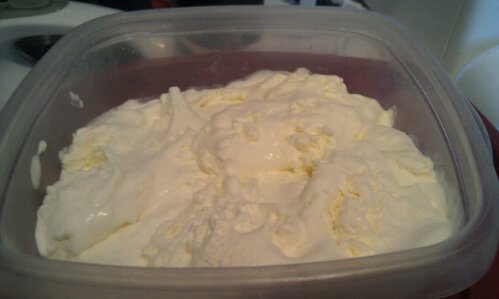
Second, I whipped the cream until it was nice and solid looking, and placed this “cream” component in the freezer (which I later moved to the refrigerator, because the cream was getting too hard):

image

Finally, I put a pinch of salt in the bowl of egg-whites, blended them, and slowly poured in four tablespoons of white sugar. Eventually, this became a puffy cloud-like substance, which my brother tells me is meringue:

image

I placed this “meringue” component in the refrigerator, but as I was writing this I was reading about the chemical process in turning sugar+egg whites into meringue and learned something interesting. Because of the way the molecules are bonded, when they get refrigerated, the meringue becomes soggy. So, I have removed them, which may also be a mistake, but I have no idea.

When we are ready to drink, I’ll combine all three parts and add some nutmeg.

TIME PASSES…..

Many hours later…

Rachael is of the belief that I added too much Laphraoig, and I cannot deny her. She is the expert at these things. The components have had a rough trip and have been sitting idly by for hours. This has caused the meringue to return to a very liquid state: the foam is now resting atop a layer of goo. The cream has also lost form, but that is more easily recovered. We are quite full and ready for a desert at this point, so we figure the current mix is worth a shot, and we can remedy it later.

The following shot is of Rachael combining the ingredients. She is more experienced at this sort of thing than I am, and this mix required saving.  She managed to bring the mixture back to a regular meringue state.  Her hands are better looking in real life. My phone camera sucks…except of course when you pretend you are from 1872 and realize this is an f-ing CAMERA built into a PHONE.

image

Victory?! Five prepared Butterscotch Scotch Eggnogs, ready for delivery.

image

It was interesting that, by volume, the meringue was larger than the yolk component by about a 2:1 ration, although it was much lighter. Also, as you can see from the photos, the nogg was very creamy. I recalled that the recipe mentioned that this might be more easily consumed with a spoon. That was certainly true. I doubt it is possible to drink this.

A close-up: it looks good. That is my beautiful thumb.

image

Very attractive evidence that consuming this nogg does not lead to immediate expressions of disgust:

image

A taun-taun, whose name may be Floyd Jr.. We will find out.

image

Actually, the Butterscotch Scotch Eggnog turned out to be a huge success. We could still taste the Laphroaig, but it wasn’t overpowering. Next time, I would use less Laphroaig, but even our biggest skeptic of the night was running back for more. But once we added in the meringue, cream, and nutmeg, this turned out to be a perfect mix.

Reflections Near Semester’s End

We have nearly completed week 15 of the 16 week semester. What can I say about this semester? How was it different? This is the third semester I have completed as a full-time philosophy instructor, and on January 11 I will celebrate my one-year anniversary. Usually at the end of the semester, my mind is saturated with stress and I am so desperate to finish the semester that I am literally panicked. I become obsessed with the relief of break and have difficulty thinking about anything else.

This semester is very different. I am calm. Yes, I have a tremendous amount of work, and most of my time is devoted to that or taking short, necessary breaks. But it is not an anxiety-ridden work. It is diligent, calm work, and it feels good. Yes, I am still eternally behind in some of my work, but I do not feel guilty about it because I am giving it my all. If I have made a mistake, it is because I have taken on too many responsibilities and not prioritized as well as I could have. But even with these charges, I know that recognizing what I am capable of accomplishing and the ability to prioritize are both skills, and they are skills that I have been practicing and slowly improving.

What is the reason for this relative calmness? Well, last Spring was my semester first as a full-timer. I was overwhelmed by the higher expectations, and the beginning of the semester was filled with such optimism and over-confidence that I did not get my organizational machine in order, which I paid for in the end. For the summer semester, I put a lot of energy into creating a better organizational engine. It worked very smoothly, despite the fact that my life kind of fell apart temporarily in July due to tenure-portfolio demands and a battery of events I had to attend. But I understood what worked and what didn’t, and I put them into affect this Fall. I complained at the beginning of this semester that I was not given enough time to modify and plan for my courses, thanks to Faculty Development Week and Registration (both massive wastes of time) . But in the end, it actually worked in my favor. Because I did not have time to change anything at the beginning, I did not go through my usual stress of learning how to use a slightly different system of teaching.

I am overall satisfied with the improvements made in my Logic class. I learned some basic explanatory techniques at the end of last Spring that seemed to “catch” some students that were not getting caught before. They are subtle. I tried to weave them into my normal routine and I believe it helped. I know that I have fewer lost students than normal, and the radical split between those who “get it” and those who “do not” is not really present this semester. Instead, it looks like a normal bell-curve. Although I am sure there are students who still do not get it, at this point I know that it is because they are not doing their homework, they are not trying to understand  on their own, or are not showing up to class: all things that I warned them were necessary in order to prevail in logic.

I have grown dissatisfied with the book we are using in Logic: David Kelley’s The Art of Reasoning. I like it, and I like Kelley’s explanations, his approach, and the no-nonsense approach. The book is also relatively inexpensive, especially for Logic books. But my students need more practice problems. And given my approach, I like the history of the art’s development that is found in the Copi book. But damn you Copi publisher, why do you need another $100 edition every two years? Logic is almost unchanged since Aristotle you mother f*ckers, with the marked exception of Frege, a relative newbie who revolutionized logic…over a century ago.  Maybe I will just write my own stupid book.

The “Philosophy of Religion” is a tough nut to crack. I usually use anthologies. In the anthologized essays’ ability to captivate my students’ minds, however, they seem spotty. Sometimes it works well, sometimes an essay is universally despised to no good affect (Hello, Rathner!). Now, there could be a few reasons for this: first, due to the contentious nature of the subject and the complexity of the essays, the strong emotions that sprout from my students regarding different topics are harder to predict. Sometimes they lead to great discussion, and other times very difficult deadlocks. Second, because of the much more vast collection of authors and subjects, it happens that I am not an expert on each and every essay like I am in my “Ethics” or “Enlightenment to the Present” class. As a result, I find myself struggling to understand points that I did not anticipate during the class itself. Now, this is kind of bad and kind of cool. It certainly provides the potential for unique learning experiences. Philosophy is, after all, a field of wonder, and what mortal is a legitimate master on this subject? No one: and even the relative masters need to deal with their lack. And this can be a tool for a more important lesson than understanding the essay. But did I use these opportunities well? I am not sure I did, especially this semester. Third, the quality of these essays are just spotty. In “Ethics,” I only deal with proven giants: Confucius, Plato, Nietzsche, and Aristotle. Even when I am having an off day, Plato is still brilliant and can save the day. But when I am having an off day with a thinker who will be forgotten in 50 years? Yeah, then the whole day is bad and I want nothing more than to forget.

I believe that in the future, I will switch to a more pure Great Books model. Pascal’s Pensees, Kierkegaard’s Fear and Trembling and Concluding Unscientific Postscript, James’ Will to Believe, Humes’ Dialogues concerning Natural Religion, excerpts from Augustine, Maimonides, Aquinas, Nietzsche and Wittgenstein, and so on. That would make for excellent material. But while the European male “model” (“fall out” is a better term) has largely worked so far in Ethics, it would, I believe, fail in Religion. And I will not include Lao Tzu’s Dao te Ching or the Upanishads: they are great books, but they are not philosophy.

Anyway, because of scheduling, I am taking at least a semester break from both of these courses, so I will have time to think about this.

Ethics, ah, Ethics. My flagship. My beloved. My slow work of art. “Ethics” and “Introduction to Philosophy” were the first courses I taught, but whereas I have gone long expanses without teaching Intro, I have taught Ethics every single semester, usually two sections, with the exception of one or two summer semesters. It is also the subject that brought me into philosophy. And the books that captured me the most: Plato’s Republic, Spinoza’s Ethics, Aristotle’s Nichomachean Ethics, Nietzsche’s Genealogy of Morals, and Hume’s Enquiry Concerning the Principles of Morals, are all ethical books (duh). And so I have invested more time, more heart, and more thought, and have had the greatest opportunity to experiment and observe, than with any other subject.

For the first few years, this course relied on a single anthology, and it worked well. But for the Spring of 2010, I switched to four classics: Confucius’ Analects, Plato’s Republic, Aristotles Ethics, and Nietzsche’s Genealogy. This worked well in the Spring. I switched it up a bit this fall so that the order went Confucius-Plato-Nietzsche-Aristotle. Obviously counter-intuitive, because it went from the obvious chronological approach to something that didn’t seem to make sense. But there was something about how my students’ minds were shifting from Plato to Aristotle to Nietzsche that made me feel like an important revolution was not occurring. Also, there are enough students who get kind of lost in the despair of Nietzsche (without the accompanying recovery) that ending a semester with him can make many students feel a loss walking out. There is actually much more to say about this, but I will leave it be for now. Aristotle, on the other hand, does not really contradict or overwhelm Nietzsche, and in fact is in many ways an early version of Nietzsche. So if a student loves Nietzsche, Aristotle will not really persuade them to reject Nietzsche, but will instead give them new things to think about to add on to Nietzsche. Also, Aristotle is practical and straightforward in ways that Plato and Nietzsche are not. He is down to earth, and he provides something to work toward. From the many awesome conversations I have had with some of my brightest students lately, I am convinced that my plan is working well: my students are engaged, thinking, creating their own morality, and getting excited in intelligent and creative ways. I did not see this as much last Spring.

So, I’m just going to say it: the book order is kind of brilliant right now. The interplay that the ideas and writing styles on my students’ psyche has worke-d just as I hoped. When you’re dealing with a large number of students, obviously it will not be the best for everyone, but it worked better than it did in the Spring.

But it was still far from perfect. I had many class sessions that were not as exciting as they could have been. Sometimes I lectured too much, sometimes I let students’ input go to far afield without appropriate feedback from me. The timing of the writing assignments is still off, and students still did not use Plato sufficiently in the Athens game. I am still underestimating how much preparation I need to do for Aristotle since I switched translations: I am an expert on my old edition, and a neophyte on my current one. Pieces of the text that I could find and understand with ease before, I struggle to find and explain now. I love my new translator, but I do not know him like I knew my previous one.

In some ways, I am quite happy with the “faults.” In one of my Ethics classes, I have a couple of excellent, hard working students who have opposite criticisms of the way class is being done. One student wants far more discussion, where I sit on the sideline and only gently guide the conversation. Another student wants lecture, and gets frustrated when we spend too much time letting everyone talk. Who do I serve? This is Charybdis and Scylla, except in this case they are overlapping. No matter what I do, if I am trying to please one side, I am necessarily frustrating the other. I take comfort in knowing that I am frustrating them both fairly equally.

If there is one thing I’m worried about, it is that I am perhaps not thinking about teaching and the content as much as I once did. Thanks to the greater involvement in administrative duties that the full-time gig brings along, somewhat less of my mind is devoted to the heart of my job. In the past, when I am very frustrated in how a class went, I am driven, almost obsessively, to think about how I can improve the class. This has often led to revolutions of varying degree in how and what I teach. But I simply have not felt that frustration like I have in previous semesters. Yes, I have walked away from a class frustrated, many times, this semester. But I shake it off, and I don’t think about it obsessively. This has been great for my mental health. But is it great for my growth as a teacher? And if not, and if I realize this down the road, it may not be great for my mental health in the future.

Speaking of mental health: now that I am in my “career job,” or at least a job that I could happily make my career, I really need to think about my non-professional life. Ironically, I have become more focused on work now than I ever was before. Fewer things distract me, and I am more likely to read philosophy because I love it than I have since I started teaching…maybe even since I was a freshman in college. And yet somehow, I have made more time for friends than I have in previous semesters. Sure, my dating life is in a coma right now, but that can wait a bit longer. I do not even want to date.nIt’s time to read some Nietzsche, after all.

I suppose I am done. I suppose I have  now at least recorded everything that I need to recall to review for future semesters.

Well, one last thing. I love teaching Aristotle. I love teaching all four of these guys, actually. They remind me, and they force me to review my life in alternative ways every semester: precisely the goal that Nietzsche and Aristotle believe is necessary for the best life. And despite all the philosophers exciting  me, especially Nietzsche, my life is always best when reading Aristotle.

Hmm…but has the pursuit of excellent habits actually served to slowly mute my heart? Well, that’s a question for another time.

What am I?

Which statement seems more accurate way of thinking about the self, the more enlightened way?

A.

Who I am is who I am today. Who I was in the past is not who I am anymore. Who I am in the future is who I will be, but neither of these are of great concern for today. I am 32 years old. I woke up this morning at 8am, which is three hours later than I intended, but that is my fault, because I stayed up too late last night talking to some friends on Facebook. When I woke up, I read a chapter from a novel I have been reading, then, with great reluctance, got out of bed, put on my gym clothes, and did sets of pushups until I could not do any more. Then I went to the gym, did cardio for an hour, but was reluctant the whole time and it was a mediocre workout. I was probably not into it because I have skipped the gym for the past two weeks in order to get caught up with grading papers. When I got home, I sluggishly got into the shower, shaved, got dressed, and ate breakfast. I checked the news and walked out the door. The whole morning not only started three hours late, but when it finally did get started, I spent twice as much time as I needed to on every activity, except, of course, my physical activity, while ran my average length, but it was less strenuous than normal.  Two more weeks of school, two more weeks of hard work, and then my time is all my own for three weeks to do what I wish, whether that be drinking heavily or reading some excellent books.

B.

Who I am on November 29, 2010 is just one small slice of who I am. I am Kamran of Nov. 29, 2000, and Kamran of 2020 (assuming I have yet to die). Although the future is as yet uncertain, I have been able to advance every year so far, some greatly, some only marginally. I have my goals, both in my career and my character, and I have marched slowly toward these goals. Sometimes my goals have shifted, but I realized that by moving toward one goal, I have become better suited at my other goals. Certainly, not everything has been smooth: my future has at times looked bleak, I have often not gotten what I craved, and I have done things that I regret. Thinking about these things brings me a variety of pains. Nevertheless, they prompt me to thinking about my life, and the pain helps me remember. I learn things from these reflections that I would not if I forgot them. And certainly , not everything about the future will be bright as well. People who I know and love now will die. Perhaps some of them will die painfully. Perhaps relationships that I have been putting off will later become unattainable to me. Perhaps I will fall upon economic hardships. Perhaps I will find myself doing something that will cause all of my friends and family to scorn me. Maybe I will acquire a slow, painful, and inevitable cancer. Perhaps I will never write a book.  If my 1995 high school junior self could see me today, he would be puzzled in many ways, and maybe call me evil, but perhaps overall excited and proud. My 2010 self looks back on my 1995 self and sees an ignorant child.  My 2003 self would probably look at my 2006 self with disappointment and worry. But my 2006 self would look at my 2010 self and regain confidence. With any luck, on the morning of Nov. 29, 2060, I will wake up as a 92 year old man. I will look at the sun rise, sip on some hot, black coffee, think back through the years, back to the old days of 2020s, 2030s, 2040s, and the recent 2050s, and I will find my reflections to be a treasure trove of happiness.

Conclusion:

Are these different psychologies? Do they have different psychological and moral implications? Does one of these lead my life to become more full? Does one of these lead my life to be more worth living?

What is a student?

I need to keep this short, because there is work to do:

A student is not someone who registers for a class. That is just a person that has paid money for permission to sit in a classroom and get a grade in a few months. A student is someone who wishes to change the content of their mind, who cannot see clearly what counts for improvement of  that mind, who is willing to some extent to submit themselves to a teacher and to trust that teacher to assist them in improving that mind.

This is a flexible definition, and the ‘teacher’ does not necessarily need to be a person. Socrates-Plato, Kierkegaard, and Nietzsche are some of my best teachers, and they were all dead a long time before I was born. But they enter into a discourse with me every time I read their books. They even live within me to some extent, and there is an apparition of a teacher in my life wherever I go.

Plagiarism

Is there anything I hate more? Is there anything that gets me so angry at a student and makes me feel that I’ve wasted months trying to teach someone who hasn’t even been listening?

Many students don’t seem to realize that our minds are machines, and that if I have seen how the machine works, I also can detect when it is claiming to do something that it is not yet capable of doing. Even if the student has been quiet, I have been watching, listening, and reading. If the student writes something that was not thought on his or her own, I will smell it out. And the paper will fail.

Dear students: I don’t need you to be right. I don’t need you to be geniuses. I need you to make the attempt. I need you to test the capabilities of your mind and not fear being wrong. If you do that, I can help you. If you do that, I will do my best to be a mechanic and show you better ways to organize your thoughts and cultivate your mind. But if you plagiarize, and if you are afraid, there is absolutely nothing I can do for you. You are literally cheating yourself, because you are choosing to remain the same. You are choosing not to be my student, and I can only be your teacher in name only.

Plagiarizing is like going to a medical doctor when you are sick and lying to her about what foods, drinks, and drugs you have been taking. How can the doctor diagnose if they have been given a lie about the causes? Plagiarizing is like going to a financial advisor and lying about how much money you have, where it is invested, and what sort of debt you are in. Plagiarizing is like a media corporation that lies to the voters. Plagiarism is a robber of truth, a blockade to truth seekers, a misdirector to all people who want to use their intellect to improve a situation.


Needed to get that off my chest before I proceed.

Thesis of the Blog

An important division of humanity, or perhaps merely of thinkers, are those who believe in supernatural explanations, and those who are committed to natural causes. The person who believes that supernatural phenomena are present, when encountering something strange and unrecognizable, will be inclined to believe that the tools of science and reason will be of no use to understanding. They will be inclined to say, “our human minds are incapable of understanding this.” But without understanding, it is impossible to make a judgment on whether or not the thing is understandable. The only implication that is certain: the person inclined to supernatural explanations will not understand.

But given the same phenomenon, the mind committed to natural causes will only say, “I do  not understand this, yet.” With the correct application of observation, hypothesis creation, experimentation and testing, this person may achieve understanding.

Nothing else is certain. Whether or not there are supernatural phenomena in the world is beside the point, and not something we can ever know for certain anyway. So there is no use in making judgments about their existence. But throughout human history, the supernaturally inclined investigators have figured out nothing of legitimate importance, because their disposition makes them intellectually impotent. The natural-cause inclined investigator, on the other hand, may often be frustrated and live a life without discovering anything of interest for humanity. But it is amongst this troupe that we find our true scientists and philosophers.

The supernatural vs. natural division is also a metaphor for another, more mundane attitude. Whenever a person is dealing with a problem, and says, “this problem is unsolvable,” without investigation, they are following the same habit as the supernaturally inclined.

What is teaching? What is excellent teaching? How can I craft my lessons, my chosen texts, the overture of a sixteen week class, to crack a layer of dogmatism in the minds of all my students? What questions, what philosophies, and what dynamic is needed to set three dozen minds on fire? How can that fire be made so bright, that they in turn spark the minds of everyone with whom they have a conversation? To despise anything that deadens the mind, and love all that awakens it? The “practical” teachers often say, “it cannot be done, and it is arrogant to think otherwise.”

On Personal Vice and Virture

Personally, I always found the 7 virtues and 7 vices to be fascinating, if not completely accurate.

Before I move on, I’m just going to throw them down. Most of us are familiar with the vices, but fewer are familiar with the virtues:

7 Cardinal Vices:

1. Pride 2. Greed 3. Envy 4. Wrath 5. Sloth 6. Lust 7. Gluttony

7 Complimentary Virtues

1. Humility 2. Charity 3. Satisfaction 4. Patience 5. Diligence 6. Chastity 7. “Abstinence” (although given how we use words today, “Dieting” might be more accurate)

First, there are at least two ways to look at them. One way is boring and oppressing, the other is interesting and uplifting.

The oppressing way, which we might call the naive view, holds that these things are bad or good because they are hated or loved by God. It requires no explanation. Lusting over an attractive person, or even masturbating, is evil simply because God said it was evil. After all, its not hurting anyone if I fantasize about a woman who I see on the other side of the street. Remember, these sins aren’t about what you do, rather they are about what you feel and think. I call it oppressing because we have these very natural human impulses, a desire to follow them, and an external, authoritative command to fight them. It is entirely negative. The only positive thing that comes from it is the doggie biscuit of God’s very conditional award-system. But it denies what it is to be human.

The other way of looking at it has nothing to do with God, and all about the human. I guess this is the “humanistic” view. Humans have these impulses, yes, and it is often very gratifying when we fulfill these impulses. However, by engaging in these impulses, our impulses often get stronger. They form a habit. And if we let ourselves indulge in these impulses too much, they can enslave us. We cannot think about anything else but our impulses. We become a slave to them. And that is why these traits listed as “vices” are “vices:” they destroy our freedom, and destroy our ability to become more excellent human beings.

On this second, humanistic view, we now have a principle by which we can determine what “belongs” in the vice or virtue category. Because of this, we might decide that some or all of these vices and virtues do not belong on the list, and that they ought to be replaced with other virtues and vices.

Many people today dislike the list overall: they see it as oppressive. But I think the reason why people see it as oppressive is because they are only seeing it from the “naive” perspective, the one that essentially idolizes the virtue as something “good in itself” and not “good for the sake of attaining real, human freedom.” But I believe that is a mistake.

Anyway, I intended to start this post by exploring what some excellent virtues and vices would be, especially for my life and the goals I have always set up for myself. But, it is getting late in the morning and it is time to prepare for class.  Hopefully I will get to this soon.


Essay Introduction as Puzzle Construction, as Mystery Setup

I need to keep this post short so that I can get back to grading and do not use this as a method of procrastination, which is usually the reason I write long blog posts.

I want to say something about writing an introduction to an essay. What I have to say is not new or revolutionary, but it is a lesson that the vast majority of my students do not understand, especially at the beginning of the semester.

I am still searching for excellent words to describe it. In short, I believe that an essay is an exploration into a question. It must be a genuine exploration, and not simply a veiled attempt to dogmatically assert what I, as the writer, have already believed.

To strike at the heart of this, I believe a writer as essayist needs to reflect upon his or her own mind. I believe that the things that need to be focused on the most are:

(A) A question

(B) The the relevant beliefs that, even if held with conviction, the writer recognizes are not completely justified.

(C) Some deep underlying belief that the author either (a) cannot reasonably doubt, or (b) will explicitly assume to be true for the sake of doubting another belief, and for which the author believes is a non-controversial, fairly widespread belief.

My hypothesis is that all good essay introductions need to consider these points.

I am not sure how to present an example of this at the moment. Perhaps this very blog post is an example. Let me try it out:

As I was beginning to write this blog post, I was adamant that I simply wanted to assert that an excellent introduction must construct a puzzle. What I mean by puzzle is that a question is provided, but there is sufficient specificity and certain considerations in place that force the idea-to-be-explored to be considered with certain constraints. This is actually very much like solving a mystery. When Sherlock Holmes is confronted with a mystery, the simple question is “who done it,” but that in itself does not trigger one’s curiosity, and there is nothing to think about. Certain details need to be clearly explained: who are the possible characters, what was the layout of the room, and a number of other conditions that may or may not be relevant. These introduce concepts that the mind, both of Sherlock Holmes as Essayist (in the sense of Attempter-Detective) and the reader, utilize to begin trying to solve the puzzle. Even as the reader witnesses with amazement how Holmes goes about solving the problem, the reader has been given enough information to begin thinking about it. And the reader often is engaged in a mystery novel by this very fact: they can consider solutions independently of Holmes and even compete with Holmes to arrive at a logical, deductive conclusion.  The reader is even in a position, by the end of the story, to say that the end of the story did not make sense, but only because the story itself gave sufficient, clear details to allow the reader to make logical sense or to find the logical missteps. If the details were vague in beginning, then the story cannot “not make sense,” because vagueness allows for more possibilities in what could be going on behind the scenes. In a mystery novel, you don’t want your vagueness in starting details. That makes for a poor mystery. You want the vagueness only in the answer to the question: “who done it.” Everything else is designed to help the reader answer that question, but alongside the attempter-detective.

Anyway, back to my three essential elements point: A good introduction requires a question. But if it is about what the essayist already believes (in my case, what an essay ought to conclude), and if the essay is going to be a genuine essay and not simply a polemic or legalistic argument, then the essayist must be willing to confront one’s beliefs and identify what isn’t justified in those beliefs. More questions are brought up in this case. If I believe that an essay ought to be a puzzle, and if this blog post is a legitimate essay into how an essay introduction ought to be constructed, then I need to find elements of my belief that I realize I have not yet justified, even

if they don’t seem convincing to me. When I have found reason to doubt my beliefs (not reason to reject my beliefs, which is different) then I create a genuine question for myself which I want to solve.

However, there must still be constraints, and this is from where the beliefs that I cannot reasonably doubt arise. These I hold to be the boundary, the details, the location of the glove, that my mind must work on. I believe, for example, that an “essay” must be an attempt. That it must be a struggle, something to spark wonder both within the reader and writer. And this need to spark wonder is a constraint. The question is not, for the time being, “should an essay spark wonder,” but “how does an essay spark wonder.”

I am not satisfied, and this answer is not complete. But it is time to get back to grading.